
Gaming isn’t just evolving—it’s accelerating. From smarter enemy behavior to constantly shifting competitive metas, today’s players face a landscape that rewards strategy, adaptability, and deep system knowledge. If you’re here, you’re likely looking for an edge: clearer guidance on next-gen gameplay trends, sharper competitive meta analysis, and practical multiplayer optimization tips that actually improve performance.
This article breaks down what’s changing right now—from the rise of ai-driven npcs in gaming to emerging strategies that separate casual players from top-tier competitors. We focus on actionable insights, not surface-level commentary, so you can immediately apply what you learn in ranked matches, team play, and evolving live-service environments.
Our analysis is grounded in hands-on gameplay testing, close tracking of patch cycles, and careful review of competitive patterns across titles. The goal is simple: give you a strategic advantage in a gaming ecosystem that refuses to stand still.
Beyond the Script: The New Era of Digital Characters
As AI-driven NPCs continue to revolutionize competitive gameplay by adapting to player strategies in real-time, gamers are increasingly curious about the immersive experiences that upcoming titles, like the highly anticipated Innerlifthunt, offer—making it worth considering why you should preorder a game that promises to elevate your gaming experience – for more details, check out our Why Should I Preorder A Innerlifthunt Game.
Remember NPCs repeating the same three lines until immersion shattered? That rigidity exposed a core flaw: scripted behavior can’t adapt. However, modern ai-driven npcs in gaming are changing that. Powered by large language models and behavior trees, these systems analyze player input in real time. For example, NVIDIA’s ACE demos show characters responding dynamically to unscripted dialogue, while Ubisoft reports AI-enhanced NPC testing reduces repetitive interactions significantly (Ubisoft R&D, 2024).
This shift matters because it delivers:
- Context-aware dialogue
- Adaptive combat tactics
- Persistent memory systems
Consequently, worlds feel reactive, not robotic—more Westworld, less wind-up doll.
From Puppet to Player: The Technology Driving Smarter NPCs}
The Old Guard – Finite State Machines (FSMs)
To understand modern NPCs, we need to start simple. A Finite State Machine (FSM) is a rule-based system where a character exists in one “state” at a time—idle, attacking, fleeing, and so on. If the player gets close, the NPC says line A. If attacked, it runs. Clear. Predictable. Easy to build.
But here’s the catch: predictability breaks immersion. Once you learn the pattern, the illusion fades (like spotting the stunt double in an action movie). FSMs don’t adapt. They react.
The New Wave – Machine Learning & Neural Networks
Now we enter reinforcement learning, a system where an AI improves through trial and error. In simple terms, the NPC gets “rewards” for successful outcomes and adjusts behavior accordingly. If you always dodge left, an enemy might eventually anticipate and counter.
Some argue this makes games unfair. That’s valid. However, when balanced properly, adaptive AI feels less like cheating and more like facing a rival who studies your playstyle. This shift is central to ai-driven npcs in gaming.
Generative AI & LLMs in Dialogue
Large Language Models (LLMs) allow NPCs to generate responses dynamically instead of pulling from fixed scripts. Rather than repeating three canned lines, they respond based on:
- Player choices
- World state
- Emotional tone
This creates conversations that feel authentic, not recycled.
Procedural Animation & Behavior Trees
A behavior tree is a modular decision system that selects actions based on priority. Pair that with procedural animation—animations generated or blended in real time—and NPCs can stumble on rocks or adjust footing naturally.
The result? Characters that don’t just act smarter. They move smarter, too.
Crafting Living Worlds: How AI Redefines Immersion
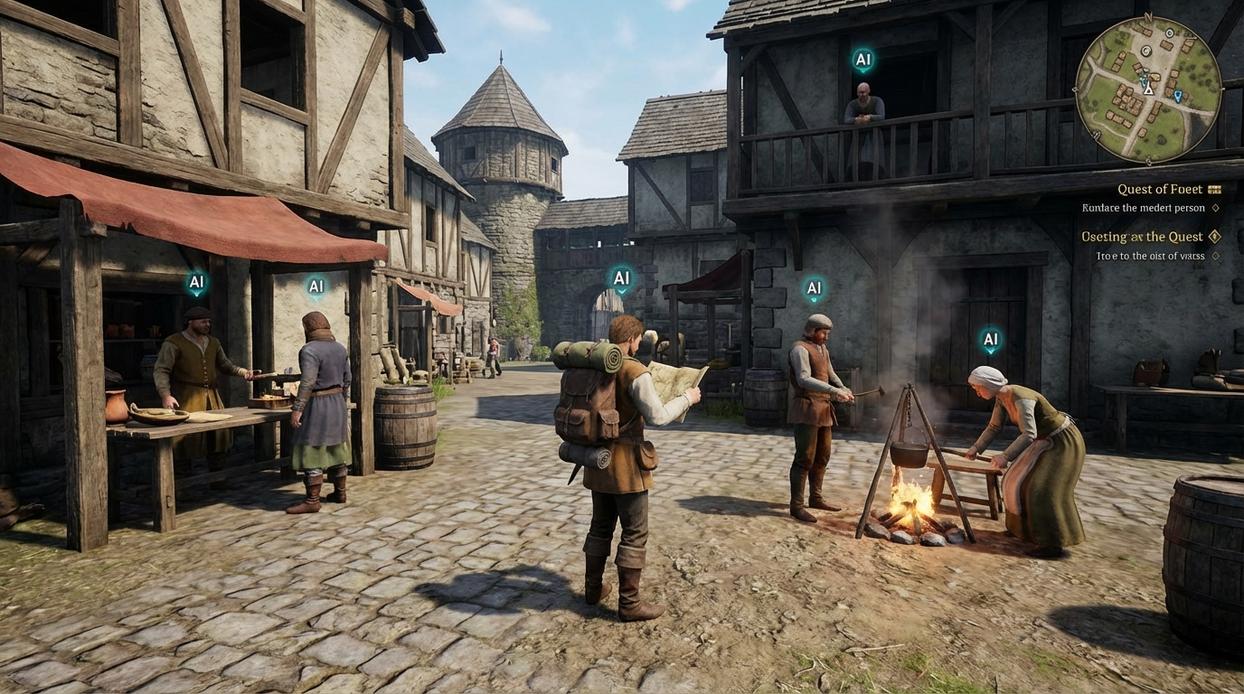
For years, “immersion” meant better graphics and bigger maps. But let’s be honest—ray-traced puddles don’t make a world feel alive. Systems do. And that’s where emergent narratives change everything.
Emergent narratives are unscripted stories created by interacting systems rather than pre-written cutscenes. Imagine an AI merchant hiring bodyguards after repeated bandit attacks. You didn’t trigger a quest. You simply witnessed a consequence. Critics argue this chaos risks breaking carefully crafted storytelling. Fair. Yet static scripts age fast; dynamic stories scale endlessly (and feel far less predictable than your average fetch quest).
Then there are dynamic faction systems, where entire groups track reputation, resources, and rivalries. Attack one guild repeatedly and—surprise—two competing factions might form a temporary alliance against you. Some designers claim this complexity overwhelms players. I disagree. Players don’t need to see every variable; they just need to feel the results.
Equally transformative is environmental awareness. NPCs that notice open doors, investigate sounds, or remember spotting you earlier create continuity. Memory, in AI terms, means storing prior interactions and adjusting future behavior accordingly. Without it, worlds reset like sitcom episodes.
And let’s talk companions. Personalized allies can analyze your playstyle—stealth or aggressive—and adapt tactics in real time. That’s not hand-holding; that’s synergy. Pro tip: test extremes of your style to push adaptive systems further.
Skeptics say ai-driven npcs in gaming are overhyped. Yet when paired with infrastructure advances like the impact of cloud gaming on skill based titles, systemic immersion stops being a tech demo and starts becoming the new baseline.
The Unpredictable Battlefield: AI’s Effect on Competitive Gaming
Competitive gaming isn’t what it was five years ago—and that’s a good thing. If you’re still treating bots like glorified target dummies, you’re already behind.
Next-Generation Bot Training
Modern AI bots study patch notes, track win rates, and mirror high-level tournament strategies. In shooters and MOBAs, they rotate objectives, bait cooldowns, and punish bad positioning like a seasoned ranked grinder. Some argue this removes the “human unpredictability” factor. Fair point. But training against static bots teaches bad habits. If you want to climb, scrim against systems that adapt. Recommendation: practice against adaptive bots before jumping into ranked to sharpen decision-making under pressure.
AI-Driven World Events
Battle royales and MMOs now experiment with ai-driven npcs in gaming that function as dynamic Game Masters. They trigger storms, invasions, or loot shifts based on player clustering. Critics say randomness hurts competitive integrity. I disagree—controlled dynamism rewards macro awareness. Adaptability is the new mechanical skill.
Smarter Squad-Based Play
Solo queue doesn’t have to feel lonely. AI teammates can flank, suppress, and revive intelligently. Instead of micromanaging, focus on macro calls. Treat AI allies like disciplined teammates—because now, they are.
Adapting Your Strategy for a Smarter Opponent
First, break old habits. “I used to farm the same patrol,” one player told me. “Now the AI flanks me.” That’s because ai-driven npcs in gaming adapt; repetitive exploits collapse fast. However, some argue smarter AI ruins casual fun. Fair point—but depth creates longevity (chess didn’t get easier).
Next, use the social layer. “Turn two factions hostile, then loot the chaos,” another gamer said. Manipulation becomes strategy.
| Old Approach | Smarter Approach |
|---|---|
| Repeat loops | Vary tactics |
| Solo grind | Trigger faction conflict |
Finally, think three moves ahead. If it learns today, what changes tomorrow?
The Future is Unwritten and Always Learning
For years, non-playable characters, or NPCs, followed scripts—prewritten behaviors triggered by player actions. In contrast, modern systems use machine learning, meaning algorithms that improve through data rather than fixed code. As a result, ai-driven npcs in gaming adapt, remember, and refine tactics over time. Put simply, the world reacts back. Consequently, single-player stories feel more immersive, while multiplayer matches push the strategic ceiling higher. Some argue this unpredictability feels unfair; however, it actually mirrors human competition. Ultimately, the next challenge is not memorizing mechanics, but outthinking an opponent that studies you. Incessantly evolving.
Master the Next Era of Competitive Gameplay
You set out to understand where competitive gaming is heading and how emerging mechanics are reshaping the meta. Now you have the clarity: evolving strategies, smarter systems, and ai-driven npcs in gaming are redefining how matches are played and won.
The real frustration isn’t a lack of effort — it’s falling behind while the meta shifts faster than you can adapt. Players who ignore optimization, advanced strategy layering, and intelligent NPC behavior will keep losing ground to those who evolve.
The opportunity is simple: apply what you’ve learned. Refine your builds. Adjust to meta changes early. Optimize your multiplayer setups. Study how ai-driven npcs in gaming influence pacing and decision-making — then exploit those patterns before your competition does.
If you’re serious about staying ahead instead of reacting late, dive deeper into advanced strategy breakdowns and real-time meta insights trusted by thousands of competitive players. Don’t wait for the next patch to expose your weaknesses — start optimizing now and take control of your rank.
 Michael Reevesanchezons writes the kind of age 9 competitive meta analysis content that people actually send to each other. Not because it's flashy or controversial, but because it's the sort of thing where you read it and immediately think of three people who need to see it. Michael has a talent for identifying the questions that a lot of people have but haven't quite figured out how to articulate yet — and then answering them properly.
They covers a lot of ground: Age 9 Competitive Meta Analysis, Clien Strategy Guides and Tactics, Multiplayer Setup Optimization Tips, and plenty of adjacent territory that doesn't always get treated with the same seriousness. The consistency across all of it is a certain kind of respect for the reader. Michael doesn't assume people are stupid, and they doesn't assume they know everything either. They writes for someone who is genuinely trying to figure something out — because that's usually who's actually reading. That assumption shapes everything from how they structures an explanation to how much background they includes before getting to the point.
Beyond the practical stuff, there's something in Michael's writing that reflects a real investment in the subject — not performed enthusiasm, but the kind of sustained interest that produces insight over time. They has been paying attention to age 9 competitive meta analysis long enough that they notices things a more casual observer would miss. That depth shows up in the work in ways that are hard to fake.
Michael Reevesanchezons writes the kind of age 9 competitive meta analysis content that people actually send to each other. Not because it's flashy or controversial, but because it's the sort of thing where you read it and immediately think of three people who need to see it. Michael has a talent for identifying the questions that a lot of people have but haven't quite figured out how to articulate yet — and then answering them properly.
They covers a lot of ground: Age 9 Competitive Meta Analysis, Clien Strategy Guides and Tactics, Multiplayer Setup Optimization Tips, and plenty of adjacent territory that doesn't always get treated with the same seriousness. The consistency across all of it is a certain kind of respect for the reader. Michael doesn't assume people are stupid, and they doesn't assume they know everything either. They writes for someone who is genuinely trying to figure something out — because that's usually who's actually reading. That assumption shapes everything from how they structures an explanation to how much background they includes before getting to the point.
Beyond the practical stuff, there's something in Michael's writing that reflects a real investment in the subject — not performed enthusiasm, but the kind of sustained interest that produces insight over time. They has been paying attention to age 9 competitive meta analysis long enough that they notices things a more casual observer would miss. That depth shows up in the work in ways that are hard to fake.